Some lists of questions to ask a buyers agent run to fifteen or more. You need seven, covering who the agent works for, how they’re paid, who does the work and how they’re regulated.
I’ve answered each one myself below, so you can see what a straight answer looks like. I’ve also added the part these lists tend to leave out: what your agent needs you to be upfront about in return. In my experience, the things a buyer doesn’t say are what cause trouble later.
Key points
- The seven questions to ask a buyers agent cover payment, licence, fees, inspections, workload, sourcing and identity checks.
- In Victoria, a buyer’s agent works under an estate agent’s licence, and you can check it yourself on Consumer Affairs Victoria’s public register.
- Ask for the total fee including GST, in writing, before you sign anything.
- Honesty has to run both ways. A half answer about your budget, your finance or who else is deciding can undo the search later.
Want to do some groundwork before you call any agent? My free AI Prompt Sheet has four prompts to work out your true cost of buying, your bidding limit and your shortlist, so you go into that first call prepared. Get the free prompt sheet.
The 7 Questions to Ask a Buyers Agent
1. Who pays you, and do you take money from anyone else?
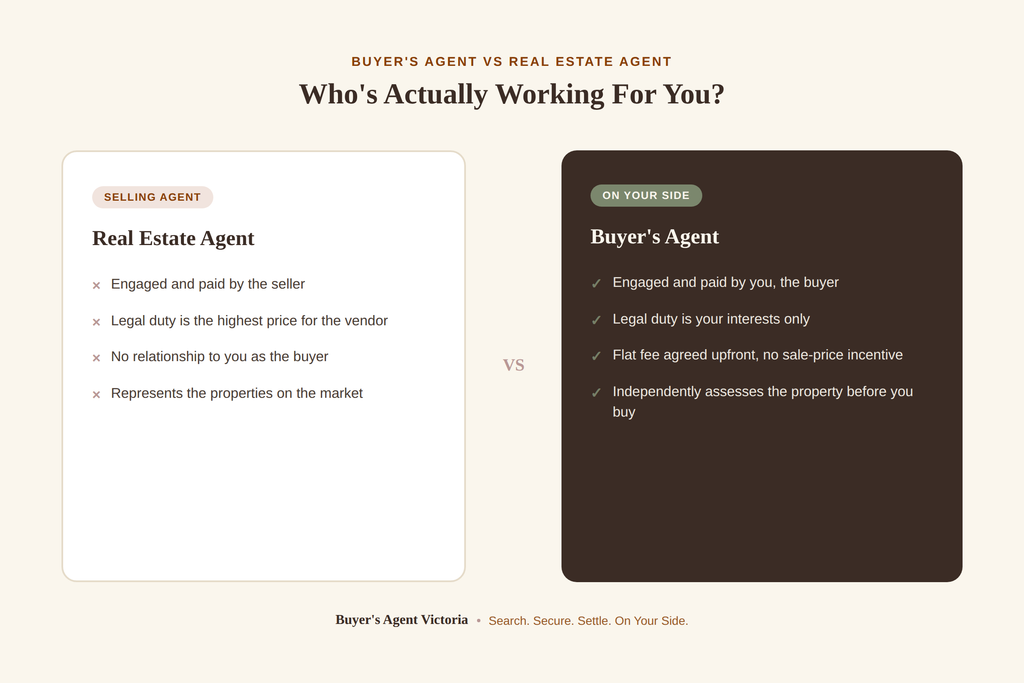
A buyer’s agent should be paid by you and nobody else. An agent who also collects a commission or referral fee from a selling agent or a developer has a reason to steer you toward particular properties.
Red flag: a vague answer, or “it depends on the property”.
My answer: I act only for buyers, and I never take a fee from a selling agent. If the two roles are blurry, read Buyer’s Agent vs Real Estate Agent: What’s the Actual Difference?
In return: tell your agent if you’re already speaking with another buyer’s agent, or if you’ve made an offer through a selling agent on a property you still want.
2. Are you licensed, and can I check it?
In Victoria, buyer’s agents work under an estate agent’s licence issued by Consumer Affairs Victoria. You can search an agent’s name on the public register of licensed estate agents in a couple of minutes.
Red flag: reluctance to give you a licence number.
My answer: my licence is 091847L and the company licence is 091857L. I’m a member of the REIV and the Property Investors Council of Australia (PICA).
In return: expect to be checked too. That is question 7.
3. What is the total fee including GST, and when is it due?
Fees come as a percentage of the purchase price, a tiered fixed fee or a flat fee, and the model changes what you end up paying. I’ve compared all three in dollars in How Much Does a Buyer’s Agent Cost in Melbourne?
Red flag: a quote that leaves out GST, or a fee nobody can put a number on until you’ve bought.
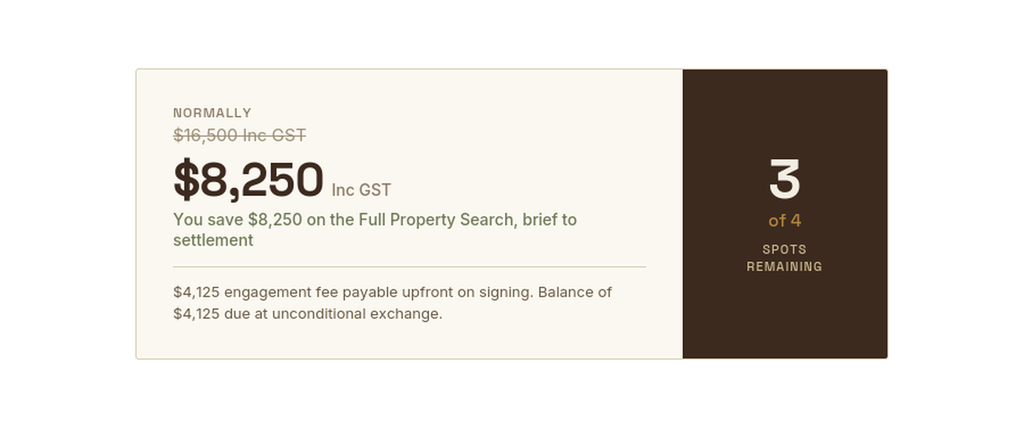
My answer: a flat $16,500 including GST, paid in four instalments of $4,125.
In return: give your real budget ceiling, including what you’d stretch to, and say plainly where your finance stands. “Pre-approved” and “talking to a broker” lead to very different searches.
4. Who inspects the properties, and is it in person?
Listing photos are staged to sell. Part of what you’re paying for is someone standing in the property and reading its condition. Ask whether the person you’re speaking to does the inspections or hands them to someone else.
Red flag: a shortlist built from listings and video walk-throughs alone.
My answer: I inspect every shortlisted property myself, in person, before it reaches you.
In return: tell your agent what you’ve already seen and ruled out, and why. If there’s a property you’ve already fallen for, say so.
Free buyer tool
The Melbourne Buyer’s AI Prompt Sheet
Four prompts to do your groundwork before you inspect, bid or sign: your true cost of buying, your bidding limit, a shortlist scorer and questions for your conveyancer. Copy them into ChatGPT, Gemini or Claude.
Get the Free Prompt SheetSearch. Secure. Settle. I’m On Your Side.
5. How many clients are you working with right now?
A proper search takes hours every week. An agent carrying a long client list has fewer of those hours for you. There is no correct number, and what you’re listening for is a straight answer.
Red flag: dodging the number.
My answer: I take on 2 to 4 clients a month, and the person you brief is the person doing the work.
In return: give your real timeframe. If there’s a deadline behind the purchase, such as a lease ending or a sale settling, your agent needs to know it on day one.
6. How will you find properties, including off-market ones?
A good answer is specific. It covers how the agent tracks what’s listed, which local selling agents they deal with, and how off-market opportunities reach them.
Red flag: a promise of off-market access on every search.
My answer: I search on-market and off-market. Some of my clients’ purchases have been off-market, including Mel’s in Mount Clear, which you can read about in Is a Buyer’s Agent Worth It in Melbourne’s Inner North? I can’t promise one for every search.
In return: separate your must-haves from your nice-to-haves, and say where you’d compromise first: price, location, the dwelling or the land.
7. What identity checks will you run before we start?
Since 1 July 2026, buyer’s agents across Australia have been reporting entities under the Anti-Money Laundering and Counter-Terrorism Financing Act. Identity and source-of-funds checks are a legal requirement before an engagement begins.
Red flag: an agent who doesn’t mention the checks, or offers to skip them.
My answer: I complete these checks with every client before the search starts.
In return: be open about where the deposit is coming from and who else is involved in the decision or the money, such as a partner or family helping out.
Why Do Your Answers Matter as Much as Mine?
Lists of questions to ask a buyers agent usually point one way: at the agent. From my side of the table, the searches that go wrong usually trace back to a half answer to one of my own questions.
A buyer tells me part of the story, often out of embarrassment or guilt, and the part I wasn’t told is the part that comes back later. It can surface at finance approval, at contract stage, or the first time a partner walks through the property.
One past investor client is a good example. He was buying through a self-managed super fund. Before we met, he had moved all of his super out of his previous fund and closed the account, which ended the death and total and permanent disability cover he held through it. He didn’t tell me, and he had decided against paying for the financial advice that would have picked it up.
I’m a property professional and I don’t give financial advice, so insurance inside super isn’t mine to advise on. It came out just before settlement, when I was going through the rollover documents and asked about his cover. By then the old account was gone. The fund’s service provider helped him arrange new cover inside the self-managed fund, and it cost him a lot more.
Had he told me at the start, we’d have had the whole search to get it sorted with the right adviser. We had the days before settlement instead. Leaving it out hurt both of us.
I’m not there to judge anyone’s finances or family situation. I ask because the brief I work from is only as good as what’s in it, and a search built on half the picture finds the wrong property.
So when a buyer’s agent asks you direct questions, treat it as a good sign and answer in full.
How Should You Use These Questions?
- Take these questions to ask a buyers agent to at least two agents and compare the answers side by side.
- Get the fee and the payment terms in writing.
- Check the licence yourself on the public register.
- Notice how many questions each agent asks you. An agent who asks little about your situation is working from a thin brief.
If you’re buying in Thornbury, Northcote or Preston, add a local one: ask which streets the agent would steer you away from, and why. An agent who knows the area can answer on the spot.
Frequently Asked Questions
What are the most important questions to ask a buyers agent?
Ask who pays them, whether they are licensed, what the total fee is including GST, who inspects the properties, how many clients they have, how they find properties and what identity checks they run.
How do I check a buyer’s agent is licensed in Victoria?
Buyer’s agents in Victoria work under an estate agent’s licence. Search the agent’s name or licence number on Consumer Affairs Victoria’s public register of licensed estate agents.
Should a buyer’s agent take money from a selling agent or developer?
A buyer’s agent acting only for you should be paid only by you. Ask directly whether they receive commissions or referral fees from anyone else. I never take a fee from a selling agent.
What will a buyer’s agent ask me?
Expect questions about your budget ceiling, where your finance stands, your timeframe, what you have already seen, your must-haves and who else is involved in the decision. Full answers give the agent an accurate brief.
Do buyer’s agents have to check my ID?
Yes. Since 1 July 2026, buyer’s agents in Australia must complete identity and source-of-funds checks under anti-money laundering law before an engagement begins.
These questions to ask a buyers agent only do their job when the honesty runs both ways. Ask all seven, expect straight answers, and give straight answers back. My own process starts with seven questions for you.
Free buyer tool
The Melbourne Buyer’s AI Prompt Sheet
Four prompts to do your groundwork before you inspect, bid or sign. Copy each one into ChatGPT, Gemini or Claude. Works for home buyers and investors.
- True Cost of Buying
- My Bidding Limit
- Shortlist Scorer
- Questions for my Conveyancer
- Bonus: Property Inspection Checklist
Search. Secure. Settle. I’m On Your Side.
Jason McCall is a licensed buyer’s advocate (licence 091847L) and the founder of Buyer’s Agent Victoria Pty Ltd (licence 091857L), based in Thornbury. He is a member of the REIV and the Property Investors Council of Australia (PICA).